


Standing on one foot is not a test of willpower. It is a skill that depends on leg strength, vision, footwear, attention, and a safe place to practice. The right approach starts small, uses solid support, and stops before you feel unsteady.
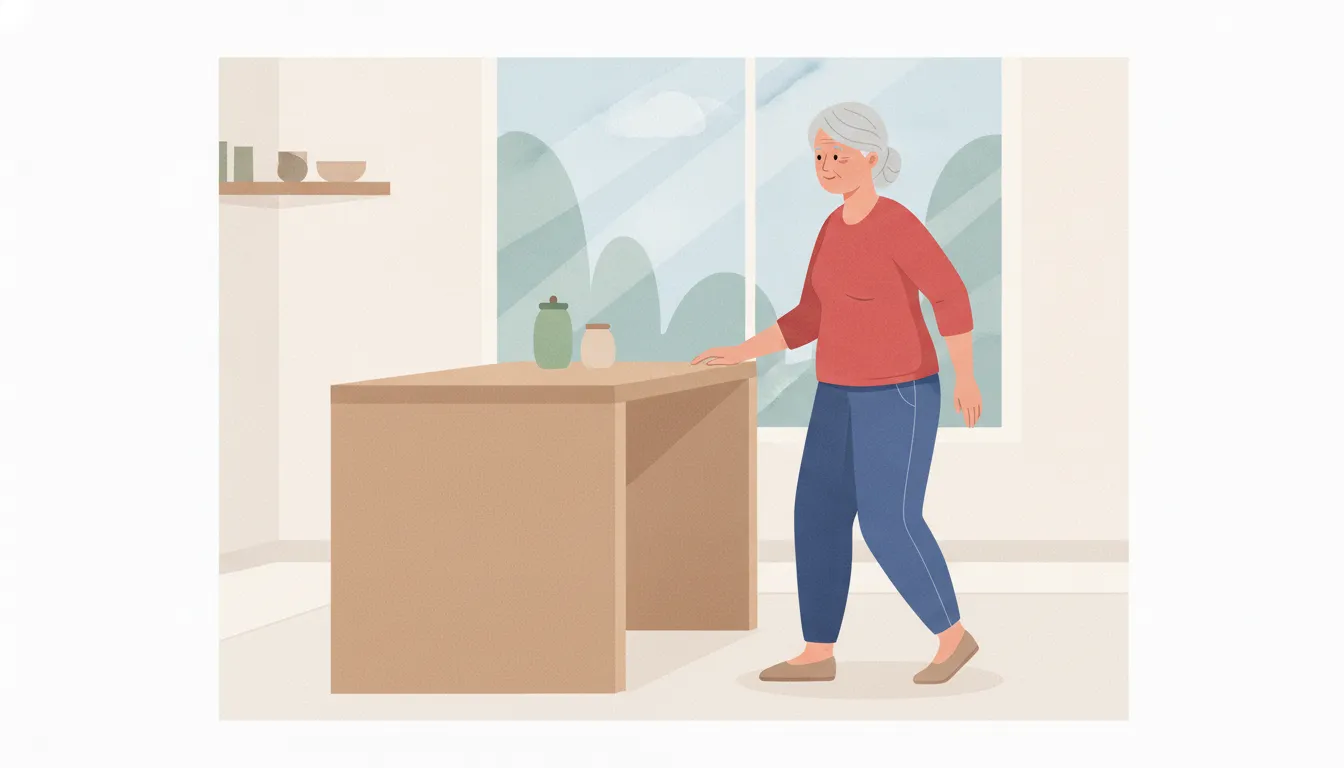
Balance exercises for seniors can include supported weight shifts, heel raises, side steps, and brief single-leg practice. Hold a sturdy counter or chair, keep the floor clear, wear stable shoes, and progress only when the current movement feels controlled. Exercise may support mobility, but it cannot guarantee that you will avoid a fall. If you have fallen recently, or you have dizziness, fainting, chest pain, sudden weakness, or a new change in coordination, ask a clinician or physical therapist before starting. The National Institute on Aging explains why balance problems deserve attention.
Have questions about healthy aging support? Contact Revival Point through the contact page.
Before choosing a routine, it helps to understand why balance often becomes harder with age and how that change can affect everyday confidence, walking, and independence.
Why Does Balance Matter More As We Age?
Balance is not just the ability to stand on one foot. It helps you turn in the kitchen, step over a threshold, get out of a chair, walk across an uneven sidewalk, and reach for something without feeling unsteady. Those ordinary movements support mobility, confidence, and independence. Balance exercises can help older adults stay mobile and independent, but they are one part of a broader activity routine, not a guarantee against falling.
The reason balance deserves more attention with age is simple: the risk of falling increases after age 65. That does not mean a fall is inevitable. It does mean that small changes in strength, coordination, vision, reaction time, or confidence can have a larger effect on daily life. A person who feels unsure on their feet may avoid stairs, stop walking outdoors, or limit social activities. Less movement can then make it harder to maintain the strength and coordination needed for everyday tasks.
Balance also depends on more than the balance system itself. Your legs and core must produce enough strength to steady you. Your eyes and inner ear help your brain understand where your body is in space. Your feet need to sense the floor, and your reactions need to be quick enough to correct a small misstep.
This is why balance work should sit alongside regular physical activity and strength training rather than replace them. Walking and other activities that keep you moving on your feet can contribute to balance. Strength work helps you manage the physical demands of standing, stepping, and recovering your position.
Lower-body strength is especially relevant. Stronger hips, thighs, and calves can make it easier to rise from a chair, climb steps, and control each step. For more context, read about lower-body strength after 60. The goal is not to chase athletic performance. It is to preserve the ability to move through your day with less hesitation.
Start with movements you can perform with stable support nearby. Keep the challenge modest enough that you can stay in control, and build gradually. If you have serious balance problems or a condition affecting your bones, joints, or muscles, ask a healthcare professional for approval before beginning. Balance exercises can support mobility and independence, but individualized guidance matters when your health history or symptoms change the level of risk.
How Can You Set Up a Safer Space for Balance Exercises?
A few minutes of preparation can make balance practice more controlled. The goal is not to remove every challenge. It is to make sure a small wobble does not become a preventable fall.
- Choose firm support. Set up beside a sturdy chair, kitchen counter, or wall. The support should not slide, swivel, or tip when you place your hand on it. Keep it close enough to reach without leaning or taking a step. NHS guidance recommends doing balance exercises near a wall or stable chair in case you lose your balance: review the NHS balance exercise guidance. A counter can work well because it gives you a continuous surface. A lightweight chair with wheels is not a safe substitute.
- Clear the floor. Remove throw rugs, loose mats, shoes, pet toys, baskets, and other objects from the practice area. Tie back or move electrical cords. Check that the floor is dry and that there is enough room to step sideways and backward without striking furniture. Checking for hazards such as throw rugs before starting is a basic recommendation for home balance practice. If you are unsure whether your setup is safe, ask someone to look at it with you. You can also read about signs of muscle loss if weakness is making movement harder, but do not use an article as a substitute for medical advice.
- Wear stable footwear. Use supportive, flat shoes that fit securely and have soles appropriate for the floor. Avoid slippery socks, loose slippers, high heels, or shoes that can catch on the surface. If a clinician has given you specific footwear instructions, follow those instructions. Do not practice barefoot on a slick floor simply because the exercise seems gentle.
- Use a spotter when needed. If you are new to balance work, have recently felt unsteady, or are practicing a movement that feels unfamiliar, ask a trusted person to stay nearby. A chair, counter, or second-person spotter can provide added safety. The spotter should remain close enough to help, not pull you through the exercise or distract you with conversation.
- Improve visibility. Turn on the lights before you begin. Avoid dim hallways, glare, and shadows that make the floor or furniture difficult to see. Keep glasses or prescribed visual aids available if you normally use them.
- Set stop rules before you start. Move slowly and keep one hand near support until you know how the exercise feels. Stop immediately if you feel dizzy, faint, unusually short of breath, develop chest pain, feel a new sharp pain, or cannot keep control of your body. Sit down safely and seek medical guidance when symptoms are significant, new, or persistent. Balance exercises for seniors should build confidence gradually, never require you to push through warning signs.
What Are the Best Beginner Balance Exercises for Seniors?
Start with movements you can control while keeping one hand near a wall, counter, or sturdy chair. The goal is not to wobble through a difficult routine. It is to practice steady weight transfer, leg control, and safe changes of position.
If you feel dizzy, faint, unusually weak, or unsafe, stop and sit down. These exercises are general education, not a substitute for advice from your healthcare professional.
| Movement | Main focus | Begin with |
|---|---|---|
| Weight shifts | Controlled transfer | Both feet planted, hand near support |
| Heel raises | Calf strength and control | Two feet, light hand support |
| Side steps | Side-to-side movement | Clear path beside a counter |
| One-leg stance | Single-leg control | Fingertips on a wall or chair |
1. Supported weight shifts
Stand with your feet about hip-width apart and your weight spread evenly over both legs. Keep your knees soft, your chest upright, and your fingertips on a stable surface if needed. Slowly shift your weight toward your right foot without lifting the left foot. Return to center, then shift toward the left. You can also shift gently forward and backward while keeping both feet planted. Pause only while you can keep good form. Mayo Clinic describes holding a position for up to 30 seconds when control is maintained, but a few seconds is enough for a beginner. See its balance exercise guidance for the basic setup.
2. Heel raises
Face a counter or sturdy chair and hold it lightly. Rise slowly onto the balls of your feet, keeping your body tall rather than leaning forward. Hold for one to two seconds, then lower your heels with control. Start with a small number of repetitions, rest, and repeat only if your ankles and calves feel steady. Heel raises challenge balance while strengthening the calf muscles used for walking and climbing stairs. If both legs feel manageable, you can later experiment with shifting a little more weight onto one side, but do not rush to a single-leg version.
3. Supported one-leg stance
Stand facing a wall with your arms out and your fingertips touching it, or stand beside a stable chair. Lift one foot just slightly from the floor. Keep your standing knee relaxed and your gaze forward. Hold for five to 10 seconds, then lower the foot and switch sides. NHS guidance suggests up to three repetitions per side, but begin with less if that is more appropriate. Holding furniture is not a failure or a shortcut. It is the correct modification when standing on one leg feels too hard. Increase the challenge only when you can keep your trunk upright and place your foot down calmly.
4. Side steps
Walk sideways along a clear counter or wall. Step one foot to the side first, then bring the other foot over without crossing it. Keep the steps slow and controlled, with your toes pointing forward. Work toward up to 10 steps in each direction if you can do so without losing control. Turn carefully rather than quickly pivoting. Side steps train the movement needed to adjust around furniture, doorways, and other everyday obstacles.
5. Heel-to-toe walking
Use a hallway or counter where support is close. Place the heel of your front foot directly in front of the toes of the back foot, as if walking along a narrow line. Look forward, not down at your feet. Take at least five slow steps, then stop and reset. Keep a hand near support, and shorten the distance between heel and toe if the full position feels unstable. The NHS recommends progressing away from the wall only as control improves.
6. Sit-to-stand
Use a firm chair that does not slide. Scoot toward the front, place your feet under your knees, lean forward slightly, and stand by pressing through your feet. Pause upright, then push your hips back and lower slowly until you are seated. Use the armrests or a cushion to raise the seat if needed. Avoid dropping into the chair or pulling on a lightweight table. Sit-to-stand adds practical leg strength to balance practice, which matters because steady movement depends on more than standing still.
Keep the area free of throw rugs and clutter, wear secure shoes, and ask someone to stay nearby if you are unsure. If you notice symptoms that affect mobility, recent falls, or a major change in steadiness, speak with a clinician or physical therapist before progressing. The best balance exercises for seniors are the ones you can perform consistently, with control and an appropriate level of support.
How Should You Progress Without Taking Unnecessary Risks?
Progress should make the exercise slightly more challenging, not make you feel unstable. Start with movements you can perform with control, then change one variable at a time. The NHS recommends doing balance exercises at least twice a week and building up slowly by gradually increasing repetitions. That is a starting point, not a test you have to pass. If twice weekly leaves you unusually sore, tired, or unsteady, reduce the workload and ask a healthcare professional what is appropriate for you.
Begin by repeating the same movement only as long as you can keep good form. For a weight shift or supported single-leg stand, that may mean a short hold rather than the full 30 seconds. Keep your trunk upright, move slowly, and use the chair, counter, or wall whenever you need it. Good form matters more than a longer hold or a higher number of repetitions. The NHS balance exercise guidance also emphasizes slow, controlled movement for exercises such as step-ups.
When a movement feels steady, progress by narrowing your base of support. You might move from a comfortable stance to standing with your feet closer together. A smaller base of support creates a greater balance challenge, so stay near a stable support and return to a wider stance if your control deteriorates. For heel-to-toe walking, start with the wall nearby and take at least five careful steps while looking forward. Only move farther from the wall when you can place each foot accurately without reaching, rushing, or grabbing for support.
You can also add forward and backward stepping after weight shifting feels safe. Take small steps and keep the movement deliberate. Reducing hand support can be another progression, but do it gradually: two hands, one hand, fingertips, then no contact only when you can remain stable. Do not remove support simply to make the exercise harder. A nearby chair or counter should remain available, even if you are not touching it.
Balance works best as part of a broader routine. Combine it with walking and strength work rather than treating one exercise as a complete plan. Walking keeps you moving on your feet, while strength exercises help you control steps and recover your position. For practical guidance on building muscle strength safely, focus on gradual resistance and movements that match your current ability. Stop if you feel dizzy, have pain, chest discomfort, or feel unsafe, and seek professional advice before continuing.
When Should You Ask a Clinician or Physical Therapist First?
Balance work should challenge you, not leave you guessing whether a symptom is safe to push through. Ask a clinician before starting if you have had a recent fall. New or worsening dizziness or vertigo, chest pain, fainting, a major change in balance, or significant weakness. New neurologic symptoms, such as sudden confusion, trouble speaking, unusual numbness, or a new change in coordination, also warrant medical attention rather than an exercise session.
Do not assume that an exercise is appropriate just because it is labeled as gentle. Serious balance problems and conditions affecting the bones, joints, or muscles are reasons to get a healthcare professional's approval first, according to Mayo Clinic guidance. Stop if you develop pain, chest pressure, shortness of breath, lightheadedness, or a feeling that you may fall. If symptoms are severe, sudden, or do not settle, seek prompt medical care.
Review medications and health conditions
Balance problems can have causes that exercise alone will not address. Certain medications and medical conditions may contribute to dizziness or instability. The National Institute on Aging notes that diabetes, heart disease, stroke, vision problems, thyroid problems, nerve problems, and blood-vessel problems can contribute to dizziness or balance problems. Inner-ear problems can also cause vertigo and imbalance. Bring a current medication list to your appointment and mention when the symptom started, what you were doing, and whether it feels like spinning, faintness, weakness, or unsteadiness. Do not stop or change a prescription without speaking with the prescriber.
How a physical therapist can help
A physical therapist can assess how you stand, walk, turn, step, and recover when your balance shifts. They can then select exercises that match your strength, mobility, vision, footwear, home setup, and fall history. The National Institute on Aging explains that patient-specific exercises can be developed by a physical therapist or another professional who understands balance and its relationship with other body systems. That individual plan may include stable support at first, a safer way to practice transfers, and gradual changes in stance or stepping rather than a one-size-fits-all routine.
Ask for professional guidance if you are unsure where to begin or if balance work exposes a weakness you have been compensating for. You can also learn how gradual strength work may fit alongside balance practice in this guide to improve strength after 60. Education can help you prepare better questions, but it does not replace an examination or personalized medical advice.
What Else Supports Steadier Movement Every Day?
Balance practice matters, but it should not be your only movement habit. Walking is a practical way to stay on your feet and challenge everyday coordination. As Mayo Clinic explains, walking and other activities that keep you moving on your feet can support balance to some degree. Start with a route and pace you can manage without rushing. If outdoor conditions are poor, walk indoors in a clear hallway or another familiar area.
Strength work belongs in the same routine. Balance and strength affect each other, especially when standing from a chair, stepping over a threshold, or carrying groceries. Mayo Clinic recommends combining balance training with physical activity and strength training rather than treating balance as a separate task. Simple movements such as sit-to-stands, supported heel raises, or carefully chosen resistance exercises can help you practice useful movement patterns. The right amount depends on your current ability, health history, and clinician's advice.
Make steady movement easier at home
Small habits can remove avoidable obstacles. Keep commonly used items within easy reach. Leave a clear path between the bedroom, bathroom, kitchen, and main sitting area. Use adequate lighting, particularly at night, and avoid walking while carrying more than you can safely manage. Wear secure, well-fitting shoes rather than loose slippers when you are exercising or moving around for extended periods.
Do not ignore recovery. Regular sleep, enough fluids, and meals that support your overall health can make daily activity easier, but they are not substitutes for balance training or medical care. If fatigue, dehydration, medication effects, pain, or a new health problem is changing how you move, speak with a healthcare professional instead of pushing through it.
Nutrition may be one part of a broader muscle-support plan. Revival Point's muscle support for older adults is offered as educationally informed nutritional support, not as a product that prevents falls or replaces exercise, physical therapy, or treatment. Keep the focus on consistent, safe movement and individualized guidance.
Want more practical healthy-aging guidance? Contact Revival Point through the contact page.
Frequently Asked Questions
What is the best balance exercise for a beginner?
Start with supported weight shifts. Stand near a stable chair or counter with your feet about hip-width apart, then slowly move your weight from one leg to the other. This lets you practice control without immediately standing on one foot. Keep both hands close to support and stop if you feel unsteady.
Can I do a short balance routine at home?
Yes. A short routine can include weight shifts, heel raises, slow side steps, and supported one-leg stands. Clear throw rugs and clutter first, wear secure shoes, and exercise near a wall or stable chair. Begin slowly and add repetitions over time rather than rushing to a longer workout. The NHS recommends balance exercises at least twice a week.
How long should I stand on one foot?
There is no universal time that every older adult should meet. Hold the position only while you can maintain good form, using a chair or counter for support. The Mayo Clinic describes holding up to 30 seconds when form remains controlled, but a shorter hold is appropriate if that is your current safe limit.
Should I exercise if I have fallen recently?
Ask a healthcare professional before starting if you have had a recent fall, serious balance problems, dizziness, fainting, chest pain, major weakness, or a new change in movement. Medications and medical conditions can contribute to balance problems, so do not assume exercise is the only answer. A physical therapist can create patient-specific exercises.
When should I stop a balance exercise?
Stop when you feel dizzy, faint, unusually short of breath, painful, confused, or unable to control your movement. Sit down safely and seek medical guidance for symptoms that are new, severe, or persistent. Balance work should challenge you gradually, not force you to recover from a near-fall.
Ready to Support Steadier Movement?
Small, consistent habits can help you stay active while you make safety the priority. Explore Revival Point's research-backed healthy-aging support, then contact the team through our contact page with questions about your next step. Keep your clinician or physical therapist involved when balance concerns, symptoms, or medication changes affect your routine.
